Landscape Lighting for Sloped Yards: Steps, Retaining Walls & Grade Changes
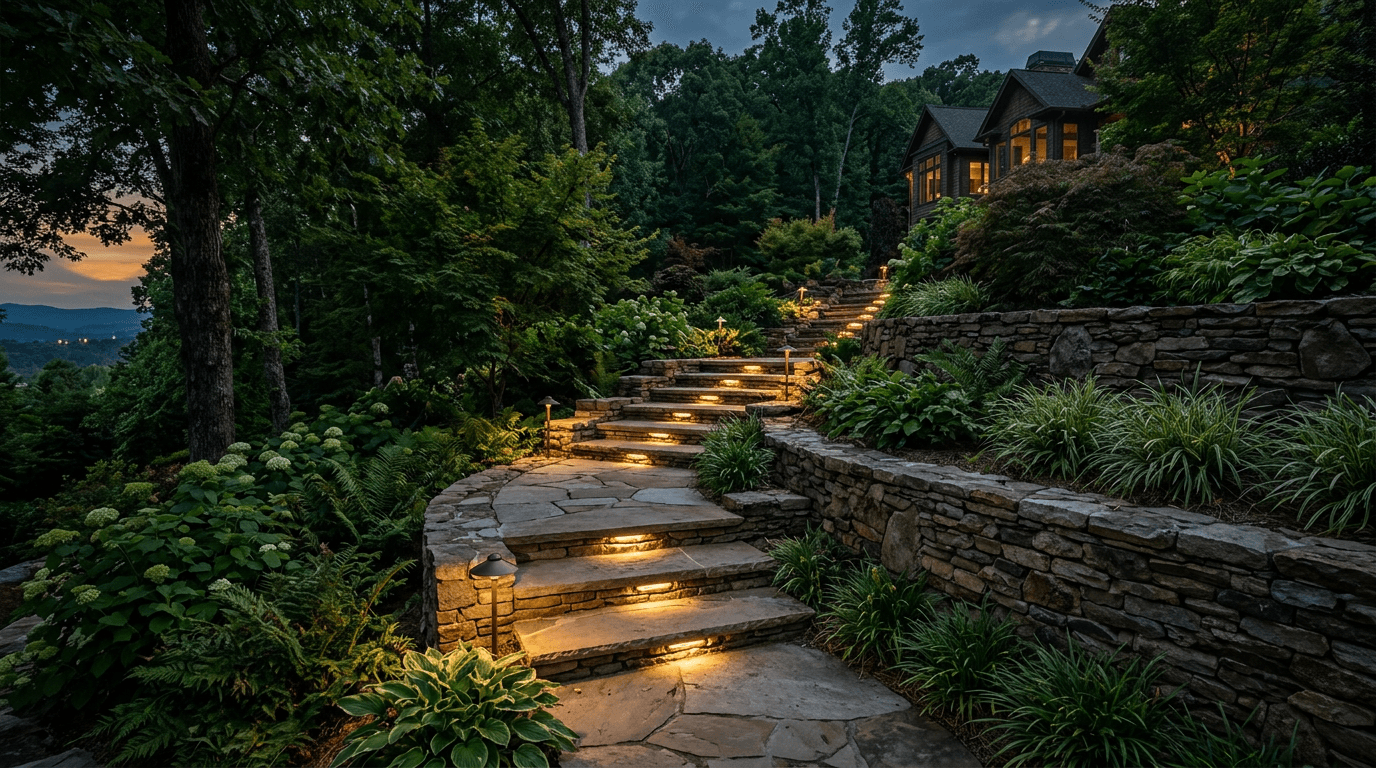
Slopes, stair runs, and retaining walls give a landscape depth, but they also create transitions that can be hard to read after dark. A successful lighting plan does not simply add more fixtures to the hillside. It uses controlled light to reveal the walking surface, changes in elevation, and the shape of the property without sending glare toward the people using the path.
Walk the grade before choosing fixtures
Begin at the top and bottom of each route and walk it in both directions. Notice where the grade changes, where a person naturally slows down, and which steps, landings, edges, or turns need clearer definition. Consider how the path is used: a front approach, a garden stair, and a route between a patio and lawn each have different priorities.
Also look from the likely viewpoints—approaching the house, sitting on a patio, or looking down from an upper terrace. A light that helps from one position can be uncomfortable from another if its source is directly visible.
Make steps and transitions easy to read
On stairs, the objective is to reveal the treads and the change in level, not to create a bright dot at every step. Depending on the construction, carefully placed step lights, nearby shielded path lights, or other low-glare options may suit the setting. Avoid placing a fixture where it creates a sharp bright spot or leaves the next tread in a deep shadow.
Landings, curves, and transitions between stone, pavers, and lawn deserve particular attention because the walking surface or direction may change there. Review the complete route at night so the sequence feels legible rather than relying on daytime plans or a fixture count.
Treat retaining walls as both structure and backdrop
Retaining walls can help define a hillside, but a row of bright fixtures along the top can make the wall visually dominant and expose the light source. Consider whether the wall needs to be seen at all, or whether the nearby stair and planting are the real priorities. If wall lighting is appropriate, a restrained, shielded approach can reveal texture without flooding the slope or neighboring windows.
Coordinate lighting with the wall’s construction and drainage details. Fixture locations, wire routing, and access for future maintenance should be considered before caps, stonework, or planting are finished. Do not drill or alter a retaining structure without confirming that the proposed work is appropriate for its construction.
Avoid glare when viewing uphill or downhill
Hillside fixtures can sit directly in someone’s line of sight, especially when a path climbs toward a landing or a seating area looks down across the slope. Shielding, careful aiming, a lower mounting position, or moving the fixture off the main sightline may improve comfort. The best solution depends on the fixture, surface, and where people actually stand.
Use only the brightness needed to identify the route and its edges. A series of intense pools can flatten the scene and make the darkest sections harder to see by contrast. Check the finished effect from both ends of the route and from nearby windows and seating areas.
Layer the hillside with restraint
Path and step lighting can provide orientation, while a small number of accents may bring out a tree, planting bed, or stone texture. Keeping those roles distinct makes the design easier to understand: circulation lighting supports movement, and accents provide visual depth. Not every retaining wall, tree, or planting bed needs its own fixture.
Warm, consistent light and thoughtful controls can help a sloped garden feel connected to the home rather than like a separate brightly lit zone. Timers or dimming can also reduce output when the yard is not in use, while keeping essential routes visible as appropriate.
Coordinate installation with landscaping
Slopes can make wire routing, fixture stability, drainage, and access more complicated than on a flat lawn. Plan routes around roots, erosion-control features, irrigation, and future planting work. The right mounting and cable approach depends on the soil, surface, and fixture requirements; avoid disturbing a bank or burying cable without understanding the site conditions and applicable installation guidance.
If you are already rebuilding stairs, adding a retaining wall, or changing a planting bed, coordinate lighting before the finished surfaces are installed. Planning early can preserve clean wire routes and make the final fixture positions easier to service.
Review the design after dark
A nighttime walkthrough is essential. Move along the route at a normal pace, look for steps or edges that disappear, and notice any lamp visible from eye level. Then view the scene from the patio, upper terrace, and street. Adjust brightness, direction, or position where the lighting feels harsh or where a transition remains difficult to read.
For a complex hillside, a professional design can coordinate path, step, and landscape lighting around the actual grade and how the property is used. The result should make movement feel more intuitive while preserving the character of the garden after dark.